
The Drone War Reaches the Grain Fleet: Five Bulkers Hit Off Novorossiysk and Tuapse as Black Sea Grain Exports Collapse
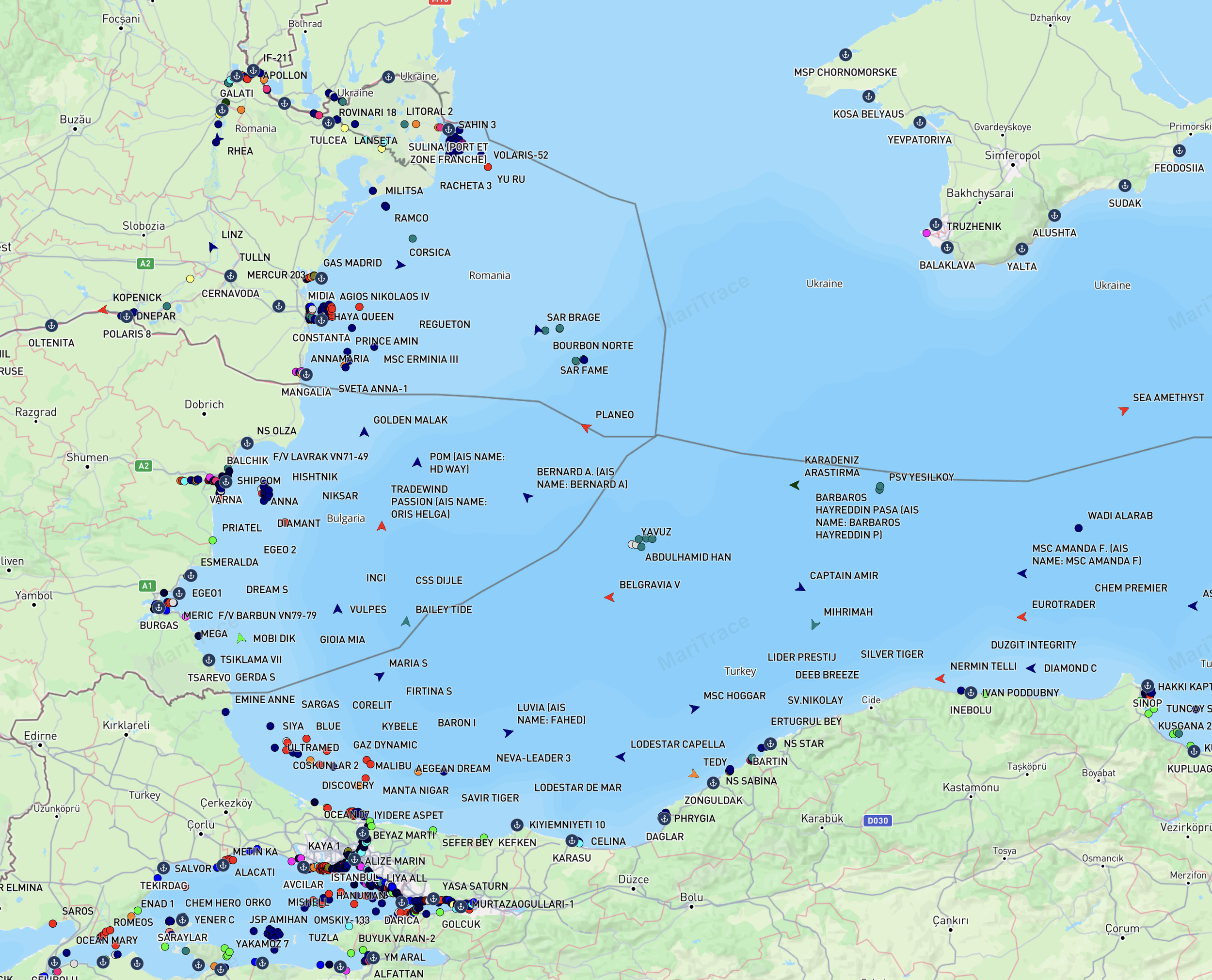
A MariTrace map graphic of the eastern Black Sea
At least five bulk carriers loading or carrying grain were attacked by drones off Russia's Black Sea ports of Novorossiysk and Tuapse on Monday and Tuesday, in what Bloomberg described as the first confirmed attacks on grain vessels at Russia's Black Sea ports (Bloomberg, via SAFETY4SEA, 19 August; via USM, 19 August). The strikes came days after a Greek-run suezmax tanker was hit at the Caspian Pipeline Consortium terminal, and they land on top of an export system that was already shutting down: Reuters reported on Tuesday that the closures of grain terminals on both the Russian and Ukrainian coasts represent a loss of more than 97 percent of the region's grain export capacity compared with last season (Reuters, via Business Day, 19 August). For most of this year, the Black Sea drone war has been fought over tankers, shadow-fleet tonnage and port infrastructure. This week it reached the grain trade itself.
The Anna S and her rescuer
The most serious of the vessel strikes was the Anna S, a Liberia-flagged bulk carrier owned by Greece's Neptune Tradebulk Inc. She was struck on the evening of Monday 17 August around 40 kilometres off Novorossiysk while on her way to the port to load grain — Bloomberg's account says barley (The Moscow Times, 18 August; Bloomberg, via SAFETY4SEA). Reportedly struck five times during the drone attack, she caught fire and was left almost completely burned out, with it initially unclear whether she remained afloat. Her 21 crew — 20 Filipino seafarers and a Romanian captain — abandoned ship and were rescued by a nearby bulk carrier, the Malta-flagged Elina B, with no injuries reported (Bloomberg, via SAFETY4SEA; The Moscow Times; Marine Insight, 19 August).
The rescue did not exempt the rescuer. Roughly five hours later the Elina B — which had loaded about 56,000 tonnes of wheat at Novorossiysk — was herself struck by drones; she sustained damage but continued her voyage towards the Bosphorus (Bloomberg, via SAFETY4SEA; via Militarnyi, 19 August).
Three more grain carriers were hit on Tuesday 18 August, according to the same Bloomberg reporting: the Russian-flagged Victoria V, struck near Novorossiysk while preparing to load wheat; the Marshall Islands-flagged Fehu, hit after departing Novorossiysk with a wheat cargo but able to continue her voyage; and the San Marino-flagged Necibe, attacked at the port of Tuapse, where she was due to load around 20,000 tonnes of wheat (SAFETY4SEA; USM; Militarnyi).
No party has claimed responsibility for the strikes on the grain vessels, and Bloomberg's reporting did not attribute them. Greek media reported that a Ukrainian drone struck the Anna S, according to The Moscow Times (18 August); none of the reports cited here carries a public comment from Kyiv on the attacks on the five vessels.
The Skiros, and the limits of the reported CPC carve-out
The grain-ship strikes followed an attack on the tanker side that tested the boundaries of the deconfliction arrangement MariTrace covered on 10 August. On the evening of Sunday 16 August, the Skiros, a Greek-run suezmax with capacity for around one million barrels, was struck by a drone near Novorossiysk shortly after loading Russian crude at the Caspian Pipeline Consortium terminal — the first reported attack at the terminal in nearly three weeks. No injuries or pollution were reported, and Bloomberg identified no attacker (Bloomberg, via Meduza, 18 August; via Euromaidan Press, 18 August).
Under the arrangement reported earlier this month — by Bloomberg and the Financial Times, citing unnamed officials, and without public confirmation from Kyiv or Moscow — Ukraine agreed to spare CPC infrastructure and non-Russian vessels serving the terminal, provided those vessels are not under Ukrainian sanctions, not Russian-owned and not carrying Russian cargo. The Skiros was reported to be carrying Russian-origin crude, which would place her outside that carve-out (Euromaidan Press; Meduza). If the reported terms are accurate, the Skiros strike would not by itself establish that the understanding had been breached — the reported protection turns on the cargo in the tanks, not the flag on the stern — though it bears repeating that no attacker has been identified. What is clear is narrower: grain carriers enjoy no reported protection at all.
An export system shutting down
The vessel strikes are the sharp end of a broader collapse in the region's grain logistics. Ukraine's SBU claimed responsibility for the overnight 12 August attack on Novorossiysk, which hit the naval base and put two major grain terminals out of action; three people were reported killed, Al Jazeera reported (12 August); Bloomberg reported this week that all three grain terminals at Novorossiysk have now halted operations (via UA.NEWS, 19 August). On the other coast, Ukraine's Odesa port hub ceased operations at the end of July, Reuters reported.
The arithmetic Reuters set out on Tuesday is stark. Russia and Ukraine together exported an average of 7.2 million tonnes of grain a month from Azov and Black Sea terminals last season; with terminals shut on both coasts, the only grain terminal not officially closed is a small facility at Tuapse with capacity of about 160,000 tonnes a month — and Tuapse is where the Necibe was hit on Tuesday. "At present, civilian shipping in the Black Sea has virtually ground to a halt," Yevgeny Karabanov of the Grain Union of Kazakhstan told Reuters. Analysts at Rusagrotrans estimate Russia's August wheat exports at 1.8 million tonnes, the lowest for the month since 2010, and Reuters put global wheat prices up 6.5 percent this month and around 30 percent higher than a year ago (Reuters, via Business Day, 19 August).
Meanwhile, the one diplomatic mechanism on the table has stalled. Turkey's proposal for a moratorium on attacks against merchant shipping — covered in MariTrace's 10 August post — has not been taken up by Moscow: Russian foreign ministry spokesperson Maria Zakharova said Russia had received no formalised Turkish proposal through official channels, while foreign minister Sergey Lavrov dismissed ceasefire calls that do not address what Moscow terms the conflict's root causes, Türkiye Today reported (14 August).
What it means for operators
The pattern of this week's strikes should reset assumptions about who is exposed in the eastern Black Sea. The five vessels hit flew Liberian, Maltese, Marshall Islands, Russian and San Marino flags; the Anna S was Greek-owned with a Filipino and Romanian crew, and was in ballast — she had not yet loaded anything. As of 10 August, war-risk cover for Black Sea port calls had already roughly doubled since late July to an estimated 2 percent of ship value, and rates for CPC-route tankers had climbed to around WS530 — roughly $400,000 a day — Seatrade Maritime News reported; London broker Gibson, cited in the same report, warned that unpredictable strikes on vessels had pushed up the cost of war-risk cover and were deterring some owners (Seatrade, 10 August). Those figures predate this week's escalation; grain tonnage calling at Russian Black Sea ports must now be priced against the same threat picture.
The Elina B's experience deserves particular attention from masters and operators: a vessel that diverted to rescue 21 seafarers was struck hours later. Nothing in the available reporting establishes whether the two events were connected — but the sequence means a Black Sea rescue can no longer be assumed to carry any protective effect, a grim consideration for anyone weighing a distress response in these waters.
Above all, the reported deconfliction understandings should not be read as a safety regime. They are unconfirmed, cargo-dependent, and — on the evidence of this week — no protection at all for the grain trade. With Moscow declining Turkey's moratorium proposal and neither belligerent claiming or explaining the strikes on the five bulkers, there is currently no publicly confirmed mechanism, formal or informal, on which a grain carrier serving Russia's Black Sea ports can rely for safe passage.
Sources
Drone strike on Greek tanker at the CPC terminal — Bloomberg, via Meduza, 18 August 2026
Russia rejects Türkiye's Black Sea moratorium push — Türkiye Today, 14 August 2026
MariTrace tracks vessel movements and maritime security incidents in the Black Sea and worldwide.