
The Strait of Hormuz at Five and a Half Months: An Oman Deal Is Close, but the Strait Isn't Open
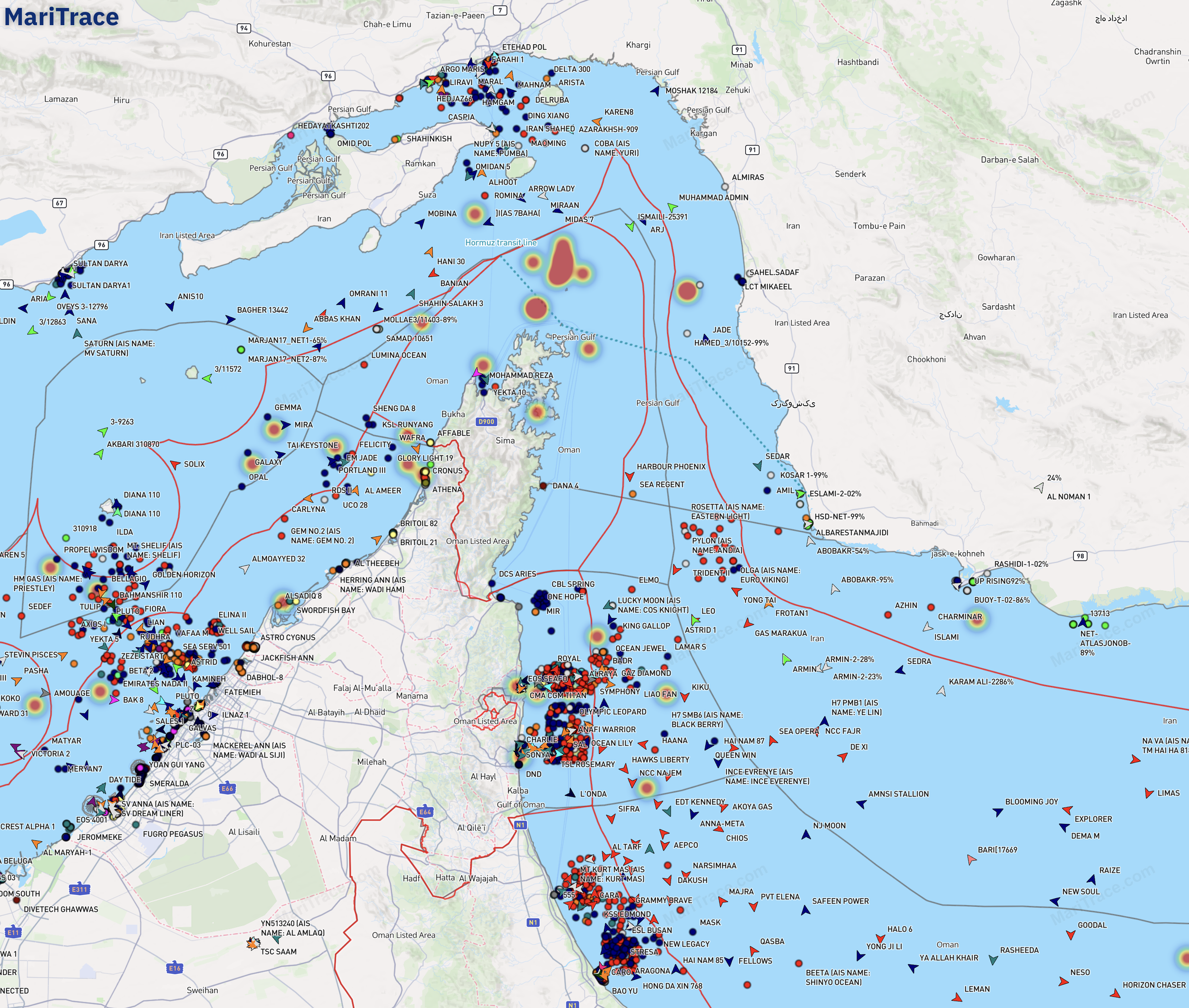
A MariTrace map graphic of the Strait of Hormuz and Gulf of Oman
More than five months after Iran shut the Strait of Hormuz, the waterway is still not functioning as a normal commercial route. Iran and Oman say they are close to a bilateral agreement on a new shipping corridor, but Tehran has been explicit that even a finished corridor deal would not, by itself, reopen the strait to the traffic it used to carry (Al Jazeera, 8 August; Reuters, via GV Wire, 9 August). Only six vessels crossed the strait on Monday 10 August, against a ten-day average of about 11 and a pre-war norm of roughly 130 to 140, Reuters reported (via WHBL); separately, the International Maritime Organization has recorded at least 64 violent incidents involving commercial vessels and 17 deaths in the region since the crisis began in late February, according to Al Jazeera (10 August). Given how much has shifted since MariTrace last covered the crisis in detail, here is how the standoff got to this point, and where it stands now.
How we got here
28 February — The US and Israel launch Operation Epic Fury against Iran, killing Supreme Leader Ali Khamenei; Iran retaliates with strikes on US and allied bases across the region. Iran was reported to have announced a ban on vessel traffic through the strait, though tankers continued moving in the immediate aftermath, according to maritime analyst Sal Mercogliano (USNI News).
4 March — An IRGC Navy official tells Iran's Fars news agency the strait is under the "complete control" of Iran's navy (Al Jazeera).
10 March — Two people familiar with US intelligence reporting tell CNN that Iran has begun laying mines in the transit channel; the scale of the mine-laying had not been independently confirmed at the time (CNN, via KTVZ). Later that month, the Lloyd's Market Association pushed back on reports that insurers had withdrawn war-risk cover, saying reduced traffic reflected crew-safety concerns rather than a lack of available insurance — its survey found the large majority of Lloyd's war underwriters were still covering hull and cargo risk in the region (LMA, 23 March).
8 April — A two-week ceasefire proposal includes a provision for safe passage through the strait, which Iran's foreign ministry says will be coordinated with its armed forces and subject to "technical limitations" (News on Air).
12 April — Talks in Islamabad collapse after 21 hours without agreement, chiefly over Iran's nuclear programme. The US military announces a blockade of Iranian ports from that day, while saying it will allow shipping to and from non-Iranian ports to continue — the start of what analysts termed a "dual blockade" (NPR; JNS).
17 April — Iran says the strait is open for the duration of a new Israel-Lebanon ceasefire; oil prices fall more than 10 percent on the news (Fox Business).
18 April — Iran closes the strait again, saying it will stay shut until the US lifts its blockade of Iranian ports (Al Jazeera).
22 April — IRGC gunboats fire on three container ships attempting to leave the Gulf — the Liberia-flagged Epaminondas, the Panama-flagged MSC Francesca and the Liberia-flagged Euphoria — and, according to Iranian state media, seize the first two; all crews are reported safe. Iran alleges the vessels were operating without permits and had tampered with their navigation systems (Reuters).
By 17 May — The dual blockade is fully entrenched. An estimated 1,550 vessels and more than 20,000 mariners are stranded in the Gulf or its approaches, Bloomberg's Hormuz Tracker reported.
17 June — The US and Iran sign a memorandum of understanding: Iran agrees to allow commercial transit through the strait with no charge for 60 days, and CENTCOM lifts the US blockade of Iranian ports the next day. The 60-day window is meant to allow further talks on longer-term administration of the strait, including possible fees after that point (NPR).
18 June–5 July — Traffic partially recovers: 513 ships transit in this window, averaging 28 a day against a pre-war average Al Jazeera put at 100 a day (Al Jazeera, 9 July), peaking at 54 transits on 24 June (UANI, 7 August).
Late June–early July — Vessels using routes not approved by Tehran again come under attack: the Ever Lovely is struck on 25 June and the tanker Kiku on 27 June. US officials blame Iran for both strikes, and the IRGC warns that vessels transiting without its approval remain at risk (Al Jazeera, 9 July).
1 July — The US reinstates sanctions on Iranian oil sales (CFR).
6–7 July — Iranian forces attack three more vessels — the Marshall Islands-flagged Al Rekayyat, the Saudi-flagged Wedyan and the Liberia-flagged Cyprus Prosperity — prompting US retaliatory strikes on Iranian targets, CENTCOM says (CENTCOM).
8–9 July — The IRGC fires on US positions in Bahrain and Kuwait; the US retaliates against Iranian targets. At the NATO summit on 9 July, President Trump says of the June MOU, "To me, I think it's over" (CFR).
14 July — The US reimposes its naval blockade on vessels bound for Iranian ports. By 7 August, CENTCOM says it has redirected 51 commercial vessels, disabled two and boarded two more since reinstating the blockade (CENTCOM, via Middle East Eye; UANI).
From 1 August — At least two ships using the Omani bypass route are struck, with at least one further attempted attack, Lloyd's List Intelligence reports (Lloyd's List Intelligence, 5 August).
5 August — Iran says it and Oman have agreed the framework for a temporary shipping corridor through both countries' territorial waters, which Iranian officials say could run for two to four months or longer — while stressing this is a technical routing arrangement, not itself a decision to reopen the strait (Bloomberg, 5 August; Al Jazeera, 6 August).
8 August — Iran's Revolutionary Guard strikes an ADNOC-linked tanker with a missile inside the strait; the UAE calls it "piracy" and reports no injuries. Separately, ADNOC says 15 of its vessels have been hit by missiles or drones since the war began — three of them that week alone — with one crew member killed and 20 injured across those incidents combined; ADNOC did not attribute responsibility for all 15 (Reuters, via WHBL).
9–10 August — Iran's Supreme National Security Council, via secretary Mohammad Bagher Zolghadr, sets out conditions for actually reopening the strait that go beyond the Oman corridor talks: compensation from the US, an end to US threats and to hostility against Iran's regional allies, lifting the naval blockade, and removing sanctions and unfreezing Iranian assets. Foreign minister Abbas Araghchi says the Oman corridor deal is in its "final stages," but that it only sets out the shipping lanes to be used once the US meets those broader conditions and the strait actually reopens (Reuters, via GV Wire; CBS News, 10 August).
Where things stand now
As of this week, two separate tracks are running in parallel, and only one of them is close to done. The technical track — a shipping corridor through Iranian and Omani waters, brokered by Muscat — is described by foreign minister Abbas Araghchi as in its "final stages" (Reuters, via GV Wire). But Araghchi has been careful to say that deal only fixes the shipping lanes to be used once Iran's broader conditions are met — it is not, by itself, a decision to reopen the strait. Even the narrower corridor deal isn't fully settled: Iran is reported to be seeking 5 to 7 percent of cargo value in tolls, against an Omani proposal closer to 3 percent, while Washington wants no fee at all (Reuters, via Cyprus Mail, 6 August).
The second track — the political conditions Iran has attached to actually lifting its closure — is far wider than a shipping route, and Tehran has kept the two deliberately separate. An IRGC spokesperson has said the strait's reopening "has its own specific mechanism and has nothing to do with the negotiations between Iran and Oman" (Al Jazeera, 8 August). Washington, for its part, is not accepting Iranian tolls or approval rights as a matter of principle — President Trump has said, "I'm not going to let them charge. Anybody's going to charge, we'll charge" (Al Jazeera, 6 August) — while continuing to enforce the US Navy's blockade of Iranian ports. Oil markets are pricing in the gap between "close to a deal" and "actually open": Brent crude surged around 5 percent on Monday to its highest since 31 July after Trump added a demand for Iranian compensation to the conditions for a deal, and continued higher on Tuesday as hopes of an imminent agreement faded. As Reuters put it, the market was responding to what remained a wide gulf between Washington and Tehran over what any agreement would actually look like (Reuters, 11 August).
What it means for operators
Transit volumes remain a small fraction of pre-war levels, and the limited traffic that is moving is a mix of Tehran-approved bilateral arrangements and vessels using the US-backed Omani bypass route — not open, flag-neutral passage. It's worth being clear that the Omani route is not an Iran-sanctioned safe corridor: Tehran has objected to it, and vessels using it have been struck since 1 August. The 8 August strike on an ADNOC-linked tanker is a reminder that even major Gulf operators are not insulated from the current risk environment.
Even if the Oman corridor deal is finalised, implementation may not be straightforward. Reuters reported on 6 August that shipping and insurance sources consider the proposed fee regime potentially unworkable: the US has sanctioned Iran's newly created Persian Gulf Strait Authority and bars US persons from paying for its "safe passage" services, while the Lloyd's Market Association has introduced war-risk wording that terminates cover for any vessel that pays a Hormuz transit fee. One insurance source called it a "catch-22" — Iran intends to charge tolls that standard war-risk policies won't let shipowners pay (Reuters, via Cyprus Mail).
With Iran now explicitly linking a full reopening to compensation, sanctions relief and an end to the US blockade — all of which remain unresolved — operators should not read news of an Iran-Oman corridor deal as a signal that transit risk in the strait is falling. The corridor, if finalised, would formalise one additional route through the crisis; it would not end it.
Sources
Iran deliberates Hormuz arrangement amid uncertain prospects with US — Al Jazeera, 8 August 2026
Gulf shipping traffic via Strait of Hormuz falls to six vessels — Reuters, via WHBL, 10 August 2026
Oil prices climb as Iranian demands cloud outlook for Strait of Hormuz — Al Jazeera, 10 August 2026
Iran begins laying mines in Strait of Hormuz, sources say — CNN, via KTVZ, 10 March 2026
Iran closes Strait of Hormuz again over US blockade of its ports — Al Jazeera, 18 April 2026
Three vessels hit by gunfire in Strait of Hormuz, crews safe — Reuters, 22 April 2026
HORMUZ TRACKER: Gridlock Persists While Blocked Tanker Sails On — Bloomberg, 17 May 2026
Strait of Hormuz: What has happened since the US-Iran MoU on June 17? — Al Jazeera, 9 July 2026
U.S. Forces Complete New Round of Retaliatory Strikes Against Iran — CENTCOM, 7 July 2026
Iran Shipping Update – August 7, 2026 — United Against Nuclear Iran
Strait of Hormuz Brief: 5 August 2026 — Lloyd's List Intelligence
Iran, Oman Reach Agreement on Proposed Strait of Hormuz Shipping Route — Bloomberg, 5 August 2026
Hormuz deal 'close': What's the latest on each side's positions? — Al Jazeera, 6 August 2026
MariTrace tracks vessel positions, AIS anomalies, and incident reports across the Persian Gulf, Strait of Hormuz, and Gulf of Oman.