
A Reported Weapons Shipment, Disputed Airstrikes, and a Second Tanker Seized Off Somalia
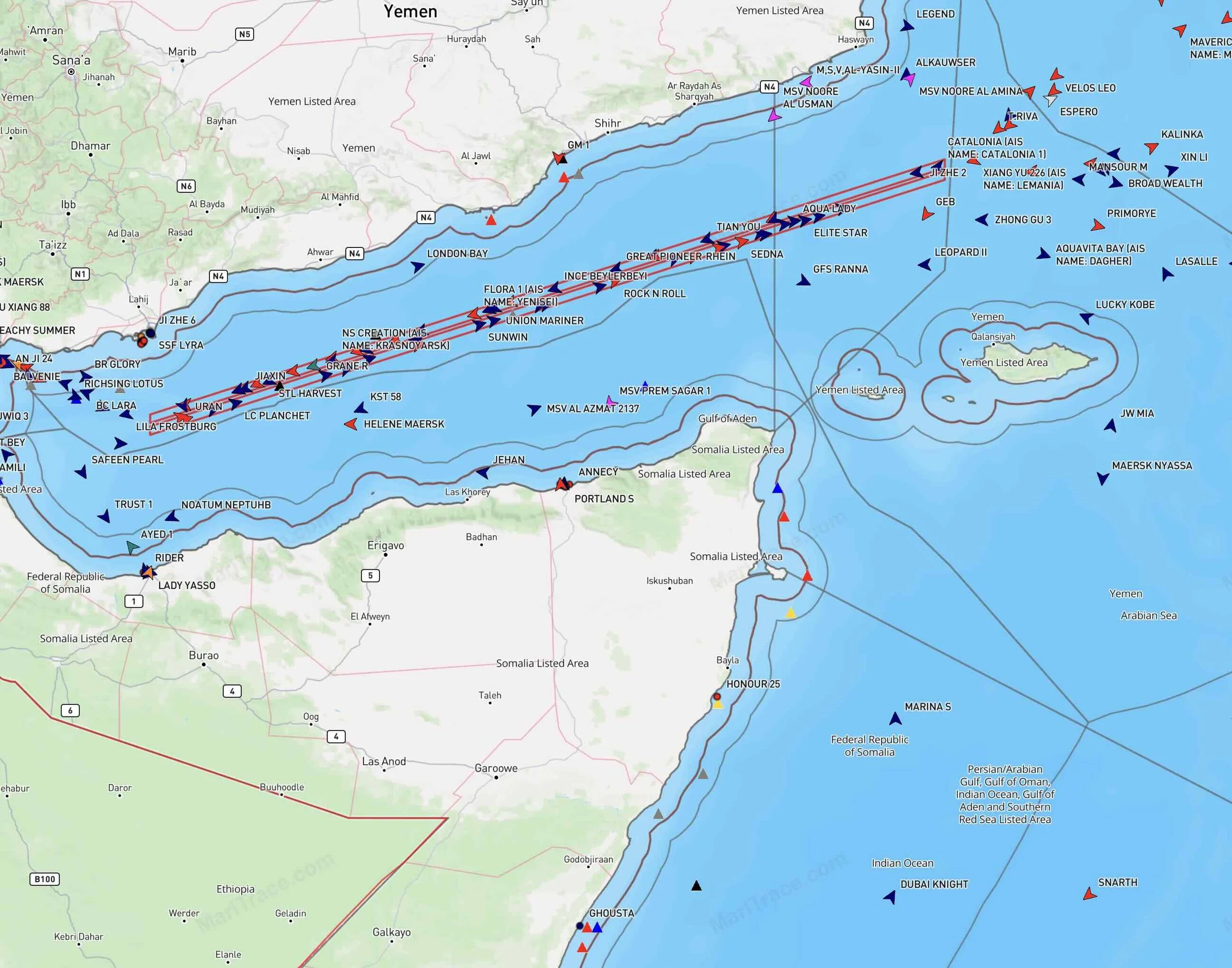
A MariTrace map graphic of Somalia / Gulf of Aden
Somalia's piracy resurgence has taken a sharper turn in the past ten days. On 17 August, armed pirates hijacked the Cameroon-flagged cargo ship Lutuf off Puntland's coast while it was reportedly carrying weapons and equipment bound for a Turkish military facility in Mogadishu (AP, via ABC News, 20 August). What followed is a story MariTrace can only partly resolve from the public record: at least two, and by some local accounts three, separate strikes have hit boats and coastal positions along the Nugaal coast since, and the picture is one of distinct, disputed incidents rather than a single casualty range — an initial strike near Garmaal reported to have killed four and wounded two, and a later strike near Jiifle, roughly a week on, reported by different outlets as killing "at least seven" or "at least nine" (The Somali Digest, 21 August; Kaab TV, 24 August; Axadle, 24 August). Whether those killed were connected to the pirates remains disputed in both cases; local reporting has identified some of the dead as fishermen. Türkiye has not denied involvement. Separately, a second tanker — the Sibu 1, sanctioned by the U.S. Treasury for its role in Iran's shadow fleet — was hijacked off Yemen on 20 August, the sixth vessel taken by Somali pirates since 21 April, according to the Associated Press (AP, via ABC News, 22 August).
Timeline
21 April — The product tanker Honour 25 is hijacked off Puntland; AP dates the current run of Somali hijackings from this incident (Maritime Optima, 5 May; AP, via ABC News, 22 August).
26 April — The cargo ship Sward is hijacked off Somalia; Puntland officials say pirates have since used it as a mothership to launch further hijackings, including of Iranian-flagged fishing vessels (The FTL Somalia, 30 April; DefenceWeb).
29 July — The Djibouti Code of Conduct Steering Committee holds an extraordinary session and recommends establishing a Combined DCoC Task Force to strengthen coordinated naval patrols across the Western Indian Ocean; DCoC National Focal Points endorse the recommendation on 5 August, with a working group tasked to develop the operational framework (Hellenic Shipping News, 18 August; DefenceWeb).
17 August — Eight armed pirates, launching from the Sward, board the Lutuf roughly four nautical miles off Mareeyo (also rendered Marraya), inside Somali territorial waters, despite armed guards on board (DefenceWeb; AP, via ABC News, 20 August).
18 August — Puntland officials and local media report the first strike near Garmaal on the Nugaal coast, close to where the hijacked vessel was being held (Wardheer News, 22 August; The Somali Digest, 21 August).
20 August — Puntland officials and local media report a second strike near Garmaal (Wardheer News, 22 August).
20 August — The sanctioned tanker Sibu 1 is hijacked roughly 136 nautical miles east of al-Mukalla, Yemen — in international waters — and diverted toward Somalia's Puntland coast. AP dates the boarding to Thursday, 20 August; some initial maritime reporting, including gCaptain's, gave 19 August (AP, via ABC News, 22 August; gCaptain, 20 August).
21 August — India's High Commission in Kenya says all 22 Indian seafarers held aboard the Lutuf and Sibu 1 — six and 16 respectively — are "reportedly safe" (ANI, 21 August).
23–24 August — A further reported strike near Jiifle/Argeegto, between Dhinowda-Dhigdhig and the Godob-Jiraan district, is described by different outlets as killing "at least seven" or "at least nine" people (Kaab TV, 24 August; Axadle, 24 August).
24 August — Türkiye's Foreign Ministry tells BBC Somali it has "no information" about the strikes — a response BBC and Garowe Online both note falls short of a denial (Garowe Online, 24 August).
The Lutuf hijacking and its cargo
The Lutuf, owned by Polar Movement Shipping, had a ten-person crew — six Indian nationals, one Turkish national, one Georgian and two Serbian security guards — and had departed Türkiye in late July, with Dar es Salaam, Tanzania shown as her declared AIS destination (DefenceWeb; The FTL Somalia, 24 August). That declared destination does not necessarily conflict with the separate claim that she was carrying weapons, along with communications and satellite equipment, for a Turkish military training facility in Mogadishu — an intermediate call or transshipment could reconcile the two — but that claim itself comes from a single Somali official who spoke to the Associated Press on condition of anonymity, saying he "wasn't authorized to speak publicly about sensitive information" (AP, via ABC News, 20 August). No Turkish or Somali government official has confirmed the cargo on the record, and AP's own report cautioned that "the circumstances of the strike, including who carried it out and whether those killed were involved in the hijacking, couldn't immediately be independently verified," adding that "the status of the Lutuf, including its crew and cargo, wasn't immediately clear" as of that report. Unconfirmed local reporting on 24 August put a ransom demand at approximately $2 million, though The FTL Somalia flagged that figure, and any named negotiating party, as unconfirmed (The FTL Somalia, 24 August). India's High Commission in Kenya said on 21 August that the six Indian crew members aboard the Lutuf were "reportedly safe" (ANI, 21 August); that does not establish the condition of the Turkish, Georgian or Serbian crew, nor does it indicate the vessel or any crew member has been released. As of the most recent reporting MariTrace has found, the Lutuf remains under pirate control and the status of her cargo is unresolved.
The airstrikes: what's confirmed, and what isn't
What is consistent across reporting is that strikes have hit small boats and coastal positions linked to the Lutuf hijackers along Puntland's Nugaal coast on more than one occasion since 18 August, and that these appear to be distinct incidents rather than conflicting counts of a single event. The Somali Digest's 21 August report named four men killed in the first, near Garmaal — Ahmed Ali Jama Dhahar, Heego Mohamed Ducaale, Waraad Yusuf Ubeed and Caydarus Yusuf Ilmi — and two wounded, and said Puntland's initial security sources described them as "suspected pirates" before residents corrected that account within 48 hours, identifying three of the four as fishermen securing their own vessel and only the boat's operator as connected to the hijackers (The Somali Digest, 21 August). Wardheer News separately reports a second strike near Garmaal on 20 August (Wardheer News, 22 August). A further strike, reported around 23–24 August near Jiifle and Argeegto in the Godob-Jiraan area, was put at "at least seven" dead by Kaab TV and "at least nine" by Hiiraan Online and Axadle, which cited Godob-Jiraan mayor Keynaan Abdi and a resident, Abdifatah Yusuf Diiriye, who told the BBC: "There were men killed there. They were on a boat, and we don't know where the boat came from" — adding that "some local youths on the boat were known in the community as fishermen," while their actual purpose that day remained unclear (Kaab TV, 24 August; Axadle, 24 August). MariTrace cannot establish from the available reporting whether this represents a third, distinct strike or whether some local reporting has conflated it with the 20 August incident; readers should treat it as a separate, unresolved report rather than assume it duplicates an earlier count. Taken together, the reporting MariTrace has reviewed points to at least 11 and potentially more than a dozen deaths across two or three strikes since 18 August — not a single event with a disputed toll. No group has claimed responsibility for any of the strikes, and the identities and affiliations of those killed have not been independently established in any of them.
Puntland's government has not accused Türkiye directly but has demanded answers. Its administration said it was investigating whether "forces outside Puntland" were supporting the new pirate networks, and separately warned that strikes "carried out without coordination with local authorities could undermine security cooperation between Puntland and its international partners," while demanding "a clear explanation of who carried out the strikes and what their objectives were" (Wardheer News, 22 August). Puntland's Ministry of Security separately said it "opposed military strikes by international forces against civilians and their property in coastal areas" (Somali Guardian, 22 August). Puntland President Said Abdullahi Deni said separately: "We are not satisfied with how things happened, and we are deeply concerned" (The FTL Somalia, 24 August). Former Somali foreign minister Abdisaed Muse Ali, who holds no current government position, went further, calling the deaths "a brutal act of aggression that the Turkish government has injected into Somalia's politics" and criticizing Puntland's current leadership for not addressing them publicly — a personal characterization, not an official government finding (The Somali Digest, 21 August).
Türkiye maintains a defence-cooperation relationship with Somalia. AP, citing the same anonymous Somali official, reported that "two Turkish-owned vessels later approached the hijacked ship, while Turkish helicopters and drones monitored the area" (AP, via ABC News, 20 August). DefenceWeb separately, citing The Somali Report, said Turkey "apparently overflew the Lutuf with helicopters on Monday" and "apparently has two naval vessels in the area" (DefenceWeb). Neither source ties that presence directly to any strike, and Ankara has issued no on-the-record confirmation of one. Asked directly by BBC Somali, Türkiye's Foreign Ministry said it had "no information" about the operation — language BBC and Garowe Online both distinguished from a denial: "There is a significant difference between a government saying, 'We did not carry out the attacks,' and saying, 'We have no information.' The first is a categorical denial, while the second neither confirms responsibility nor rules out involvement" (Garowe Online, 24 August). Independent verification of Turkish involvement in the coastal strikes has not been made public.
A second hijacking widens the picture
While the Lutuf situation was unfolding, a separate crew hijacked the product tanker Sibu 1 — reportedly Eritrean-flagged, previously named Seamull, IMO 9204776 — roughly 136 nautical miles east of al-Mukalla, Yemen, on Thursday, 20 August, in international waters; AP's report says "six armed pirates hijacked the Eritrean-flagged M.T. Sibu 1 on Thursday" (AP, via ABC News, 22 August). Lloyd's List separately covered the hijacking as the "second Gulf of Aden attack" that week, consistent with the Sibu 1 following the Lutuf, though MariTrace could not access the full Lloyd's List article, which sits behind a paywall, to confirm its own dating independently (Lloyd's List, 22 August). MariTrace notes that OFAC's own December 2025 sanctions listing for the vessel, under its former name Seamull, recorded a Palau flag (see below); the current Eritrean registration reported at the time of this hijacking should therefore be treated as reported rather than independently confirmed, and may reflect a re-flagging or a discrepancy in reporting. The 32,200-dwt vessel broadcast "PIRATE ONBOARD HELP" before being diverted toward Puntland; her 20-member crew comprised 16 Indians, one Syrian, one Sudanese, one Iraqi and one crew member of unconfirmed nationality (gCaptain, 20 August; AP, via ABC News, 22 August). India's High Commission in Kenya said on 21 August that the 16 Indian crew aboard were "reportedly safe," alongside the six aboard the Lutuf (ANI, 21 August). The vessel was sanctioned by the U.S. Treasury's Office of Foreign Assets Control on 18 December 2025, under the name Seamull and flagged to Palau at the time, over its role in what United Against Nuclear Iran describes as Iran's shadow fleet; Treasury's designation states that Seamull"transported Iranian petroleum products, including naphtha and gasoil, on multiple occasions" and had made port calls to Houthi-controlled ports in Yemen (U.S. Department of the Treasury, 18 December 2025). That sanctions history describes past voyages — it does not establish what cargo, if any, the Sibu 1 was carrying when hijacked, and AP reported that her recent port calls and destination were unclear (gCaptain, 20 August). Martin Kelly, head of advisory at EOS Risk Group, characterized the hijacking as part of "a broader resurgence of Somali piracy" (gCaptain, 20 August). AP reported the Sibu 1 as the sixth commercial vessel hijacked off Somalia since the Honour 25 on 21 April, following the Sward, Eureka, Asana and Lutuf, and cited International Maritime Bureau figures showing 38 piracy incidents recorded worldwide in the first half of 2026, with Somali pirates accounting for 94 percent of crew members taken hostage globally in that period (AP, via ABC News, 22 August). Puntland's Security Ministry said forces "beyond Puntland's control were behind the renewed piracy," without naming those forces (AP, via ABC News, 22 August).
What it means for operators
The regional naval and insurance response is still taking shape rather than fully operational. The proposed Combined DCoC Task Force — recommended by the Djibouti Code of Conduct Steering Committee on 29 July and endorsed by national focal points on 5 August — is meant to increase coordinated patrols and put "sea-rider" officers aboard participating naval vessels, but its geographical scope, composition and resourcing are still being worked out by a dedicated working group ahead of a September 2026 workshop, so its practical effect on the water is not yet established in public reporting (Hellenic Shipping News, 18 August; DefenceWeb). On the insurance side, the Joint War Committee expanded its Listed Areas in March 2026 (JWLA-033), adding Bahrain, Djibouti, Kuwait, Oman and Qatar and extending existing listed areas toward the Pakistani coast and the Somali border; a Listed Area designation does not itself withdraw or grant insurance cover, but under standard London-market arrangements and applicable policy terms, owners may be required to notify their war-risk underwriters before entry, with any additional premium and conditions then individually negotiated between insurer and assured; failure to comply with the applicable policy terms may prejudice cover (LMA; Seatrade Maritime News, 4 March). K&R insurers CFC and West P&I Club have both introduced or expanded piracy-specific products this year (Insurance Business, 21 August). The Swedish Club told Insurance Business that no vessel carrying professional armed security has been successfully seized in the current wave of hijackings, and that hijacked ships have historically been held for roughly eight weeks on average, though individual cases can run longer (Insurance Business, 21 August). That is a data point operators may want to weigh when assessing embarked professional armed security for higher-risk transits through the Gulf of Aden and Somali Basin, alongside compliance with the current BMP Maritime Security guidance, which superseded BMP5 in 2025 (International Chamber of Shipping; BIMCO, 31 March 2025).
Separately, the disputed strikes raise a harder question for anyone routing through or near Puntland's territorial waters: if a foreign military is now conducting unacknowledged strikes against suspected pirate positions on Somalia's coast, and Puntland's own government says it wasn't consulted, the rules of engagement operators should expect in these waters are less predictable, not more, even as naval coordination against the pirates themselves improves.
Sources
Somali pirates hijack oil tanker off Yemen in latest attack — AP, via ABC News, 22 August 2026
Somali pirates hijack cargo ship; regional navies setting up new task force — DefenceWeb
Garmaal Buries Fishermen the First Reports Called Pirates — The Somali Digest, 21 August 2026
Airstrike Leaves Seven Dead in Nugaal — Kaab TV, 24 August 2026
Pirates Demand $2 Million Ransom for Turkish Weapons Vessel LUTUF — The FTL Somalia, 24 August 2026
Piracy fears grow as three vessels hijacked off Somalia in week — The FTL Somalia, 30 April 2026
London marine insurers extend Middle East war risk zones — Seatrade Maritime News, 4 March 2026
MariTrace tracks vessel movements and maritime security incidents in the Red Sea and worldwide.