
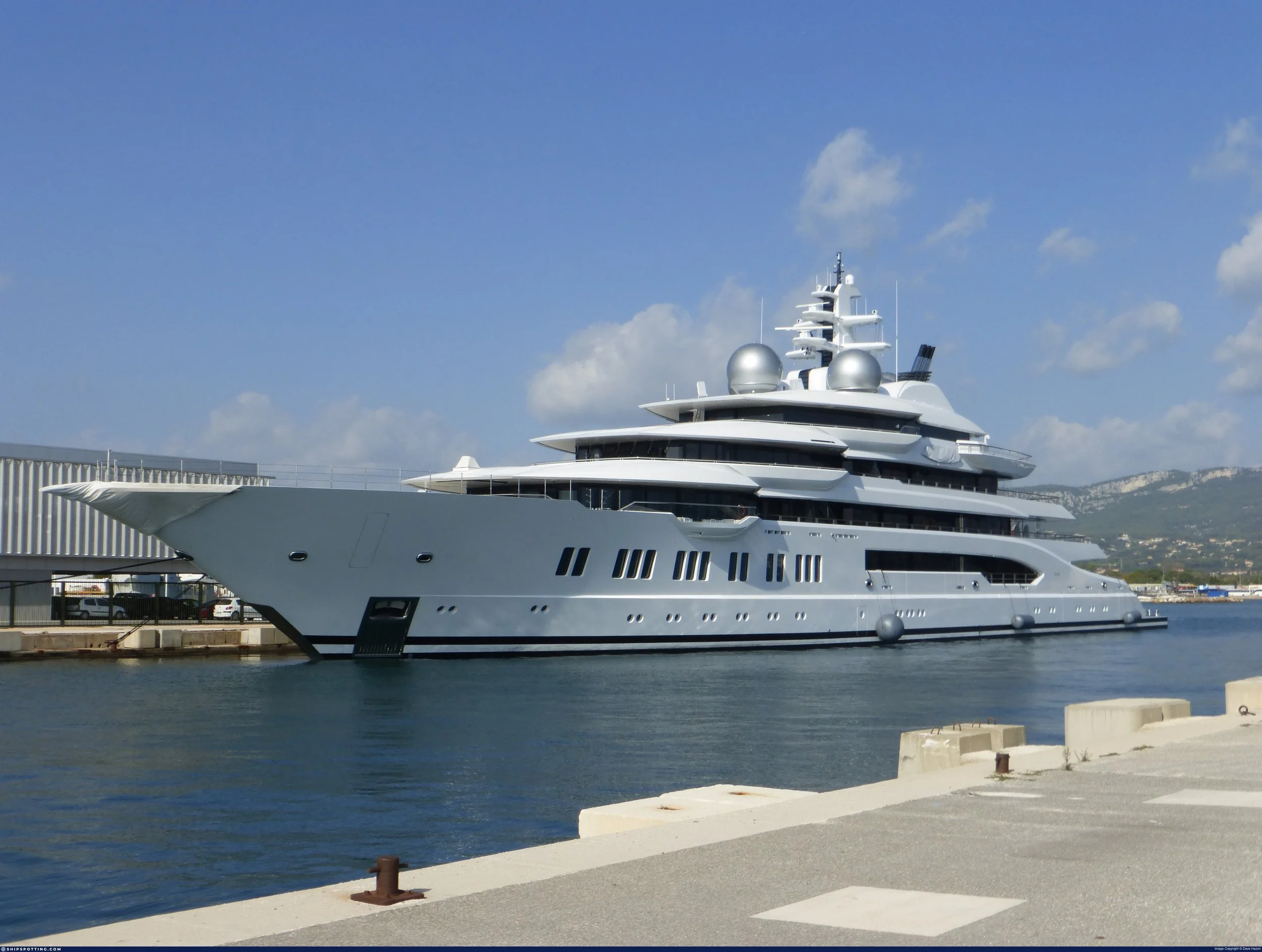
The vessel Amadea - image courtesy of ShipSpotting.com
On 1 June 2026, the US Court of Appeals for the Second Circuit effectively closed the book on one of the most closely watched superyacht forfeiture cases of the sanctions era — though not quite in the way it first appears. Eduard Khudainatov, the former Rosneft chief executive who held legal title to the 106-metre Lürssen Amadea, had argued he had standing to fight the US government's forfeiture of the vessel. The court didn't rule on who actually owned the yacht. It upheld the district court's finding that Khudainatov was a "straw" owner — someone who, as the court put it, holds title but has already handed everything else to someone else — and that straw owners "do not themselves suffer an injury when the property is taken," so have no standing to contest a forfeiture in the first place. Under a September 2021 agreement, Khudainatov's company had transferred "possession, dominion and control, any financial stake, and all other indicia of ownership" to a Cayman Islands purchaser — leaving him nothing left to lose when the forfeiture went through. The court explicitly left open the government's separate, underlying allegation: that the 2021 sale was structured to conceal the true beneficial owner, sanctioned oligarch Suleiman Kerimov (2d Cir. opinion, United States v. The M/Y Amadea, No. 25-869, 1 June 2026; Justia case summary).
Four years and two levels of the US federal judiciary after Fijian authorities, acting on a US request, seized Amadea at Lautoka harbour, that ruling is about as clean an ending as any of these cases gets (YachtBuyer, 5 June 2026). It's also the exception. Of the roughly 20 Russian-linked superyachts that eleven Western governments froze or detained in 2022, worth a combined $4.3 billion at the time, only four have ever reached a final, formal confiscation — and Amadea is one of them (Forbes, 26 July 2026). The rest are still sitting in shipyards and marinas from Trieste to Croatia, tying up court dockets and running up carrying costs that, in most of the cases examined by Forbes, Western governments have ended up covering.
What just happened to Amadea
Amadea was seized at Lautoka harbour, Fiji, on 5 May 2022, after US investigators alleged that Kerimov was the yacht's true beneficial owner (Powerboat News, 2026). The Justice Department filed a civil forfeiture complaint in October 2023, once the vessel had been relocated to San Diego. Khudainatov, who held title through a company called Millemarin Investments, tried to intervene — but the September 2021 agreement transferring the substantive benefits and burdens of ownership to a Cayman Islands purchaser undercut his own claim to be the yacht's real owner. US District Judge Dale Ho entered a default judgment on 11 March 2025 and a final judgment of forfeiture a week later, finding Khudainatov lacked the standing needed to contest it; the Second Circuit's 1 June 2026 decision affirmed that judgment on appeal, ending Khudainatov's challenge in the lower federal courts (YachtBuyer, 5 June 2026; 2d Cir. opinion, 1 June 2026).
By the time the ruling landed, the yacht had already changed hands. The US Marshals Service, working with brokers National Maritime Services and Fraser Yachts, ran a sealed-bid auction that closed on 10 September 2025 (Powerboat News, 2026). Neither the buyer nor the price was disclosed at the time, and the Marshals Service doesn't normally release winning bidders' names — but a government document that surfaced later, plus reporting from Vyorstka/the Moscow Times and Forbes, identified the buyer as Abbas Sajwani, the 27-year-old son of Dubai property billionaire Hussain Sajwani, who later invited a Forbes reporter aboard in Monaco to talk about the purchase (The Moscow Times/Vyorstka, 31 October 2025; Forbes, 26 July 2026). That later-surfaced document put the actual price at $187 million — a roughly 38 percent discount on Amadea's pre-war $300 million valuation — of which Forbes estimated Washington kept about $150 million once auction and legal costs were deducted (Arabian Business/briefs.co, 6 August 2026; Forbes, 26 July 2026).
Holding onto Amadea in the meantime wasn't cheap. Forbes put the total cost to US taxpayers at $36 million by mid-2026: roughly $600,000 a month in routine running costs — about $360,000 for crew, $165,000 for maintenance and related expenses, and $75,000 for fuel — on top of an estimated $1.7 million a year in insurance and a one-off $5.6 million drydock bill (Forbes, 26 July 2026).
The one that's still open
Sailing Yacht A, the 143-metre Philippe Starck-designed vessel linked to Andrey Melnichenko, has been held at Trieste since Italy's Guardia di Finanza seized her there in March 2022. Melnichenko has spent four years arguing the yacht belongs to an independently controlled trust, not to him personally. On 21 May 2026 the Court of Justice of the European Union ruled, in a set of joined sanctions cases concerning trust-held assets, that a designated person's "legal or de facto ability to use, benefit from, dispose of, or influence" an asset is enough to bring it within EU sanctions law's "belonging to" or "control" test — assessed from the totality of the facts, not from the trust paperwork alone (Morgan Lewis, June 2026; Megayacht News, June 2026).
That ruling, if anything, raises the bar for Melnichenko rather than lowering it. It didn't decide his case — it sent the underlying question back to the Lazio Regional Administrative Court in Rome, which must now apply that broader test to his own trust structure. Until it does, the seizure stands, and Italy keeps paying: an estimated €10 million a year to keep the yacht maintained (Megayacht News, June 2026; Yacht.de, 2026). If the Lazio court ultimately finds the freeze was wrongly imposed, reporting suggests Melnichenko could get the yacht back without reimbursing Italy for an upkeep bill reported to have reached around $47 million by mid-2026 (Luxurylaunches, 3 June 2026).
A different kind of case
Not every one of these fights is a Western government against a sanctioned Russian owner. Royal Romance, a 92-metre motoryacht seized in Croatian waters in 2022, is linked to Viktor Medvedchuk — a Ukrainian, not Russian, politician facing treason-related proceedings at home over his pro-Kremlin ties. The pursuit here is being run by Ukraine's own Asset Recovery and Management Agency (ARMA), acting on an indictment from Ukraine's Office of the Prosecutor General, rather than by a Western sanctions regime (Megayacht News, April 2026).
Two attempted sales of Royal Romance have already collapsed: an April 2024 process with Troostwijk Auctions that reportedly missed a deadline, and a May 2024 attempt by Boathouse Auctions that a Croatian court cancelled within two months for lack of the Ukrainian criminal indictment the process needed. As of this spring, ARMA had not yet been able to launch a third attempt, still awaiting a ruling from a Croatian judge before it can proceed — and it says representatives connected to Medvedchuk have mounted "increased procedural resistance," using "all possible legal instruments to block" the sale. A second yacht linked to Medvedchuk's circle, the 44-metre Amore Mio, has since been entered into Interpol's Stolen Vessels database as part of ARMA's international tracing effort with Interpol and the IMO (Megayacht News, April 2026).
The bigger picture
Zoom out from any single vessel and the pattern across all of them is strikingly consistent. Of the roughly 20 Russian-linked superyachts that Western governments detained in 2022, only four — worth about $530 million combined — have ever been formally confiscated, and three of those were sold at steep discounts to their pre-war valuations (Forbes, 26 July 2026).
That's genuinely expensive. Forbes tallied Tango's Spanish upkeep at roughly $14 million over 51 months; Scheherazade's at about $15 million and counting in Italy; Lady M's at close to $2 million, including $700 a day for electricity and water and $15,000 a month in mooring fees alone (Forbes, 26 July 2026). Zoom out further and the yachts are a rounding error against the wider seized-asset picture: of $58 billion in blocked Russian oligarch assets overall — yachts, real estate, aircraft, companies, bank accounts — only about $3 billion, or 5 percent, has been formally seized anywhere (Forbes, 26 July 2026).
Most of the remainder — Sailing Yacht A, Scheherazade, Lady M, Luminosity, Tango and others — remain caught in that earlier, unresolved stage: physically held, ownership unsettled, costs still accumulating. Dilbar is a partial exception, and a recent one: on 11 June 2026 the Frankfurt Administrative Court ruled that German authorities had failed to establish billionaire Alisher Usmanov's connection to the trust that formally owns her, undercutting the legal basis for treating the 156-metre superyacht as a frozen asset — though the ruling isn't final and remains subject to appeal (Megayacht News, July 2026; The Moscow Times, 30 June 2026).
And despite years of political promises that frozen Russian wealth could help fund Ukraine's reconstruction, Forbes found no evidence that proceeds from the yacht cases it examined — including Tango, Amadea and Alfa Nero — have actually reached Kyiv (Forbes, 26 July 2026).
What this means for owners, managers and insurers
Two things worth taking away from this that aren't specific to Russia or to any one court case.
The first is legal, and its implications reach beyond sanctioned owners. The CJEU's 21 May 2026 ruling shows that, at least within EU sanctions law, formal legal title and trust separation won't necessarily determine whether an asset is treated as belonging to or controlled by a sanctioned person — regulators and courts are entitled to look at who actually benefits from and directs an asset, not just the paperwork (Morgan Lewis, June 2026). Trust and holding-company structures still work for legitimate privacy reasons, and the Dilbar case shows a challenge can succeed — but formal separation alone may not be enough where the facts point to continuing control.
The second is practical, and it's squarely relevant to brokers, insurers and anyone considering a previously sanctioned hull. Vessels caught up in these proceedings don't emerge unscathed even once a case resolves: Phi, detained by the UK since March 2022, lost her insurance and class registration entirely while frozen (Megayacht News, January 2026). Richard Lambert of Burgess Yachts in Monaco put the buyer-side risk plainly: "Anyone buying any one of those yachts is going to have to take some very, very strong legal advice" (Forbes, 26 July 2026). And London superyacht lawyer Benjamin Maltby's assessment of the whole affair applies just as well to the ownership-verification side of the business as to the storage bills: "I don't think the authorities had a clue as to how much these things cost just to have there, doing nothing" (Forbes, 26 July 2026).
Amadea took a little over three years to go from seizure to sale, and just over four years to reach the end of its principal federal appellate challenge. Most of the yachts that were frozen alongside her in 2022 are still working through the earlier stages of that same process.
Sources
United States v. The M/Y Amadea, No. 25-869 — case summary via Justia
Final Appeal Rejected in Four-Year Legal Battle Over 106m Yacht Amadea — YachtBuyer, 5 June 2026
The Amadea Affair: Superyacht Sanctions Test Case Ends — Powerboat News, 2026
Seizing Oligarch Yachts Sounded Great. Then Taxpayers Got the Bill. — Forbes, 26 July 2026
Dubai Property Scion Pays $187M for Seized Russian Yacht — briefs.co/Arabian Business, 6 August 2026
Sanctions-Related Seizure of Sailing Yacht A Stands—for Now — Megayacht News, June 2026
"Sailing Yacht A": Sailing giant remains impounded — YACHT, 2026
Andrey Melnichenko sues Italy for yacht — Luxurylaunches, 3 June 2026
Government Hasn't Proven Yacht Dilbar Must Remain Frozen, Court Says — Megayacht News, July 2026
Seized Russian-Owned Yachts: Where They Are Now — Megayacht News, January 2026
Seized Yacht Royal Romance May Be Auctioned Again Soon — Megayacht News, April 2026
MariTrace tracks vessel movements, ownership signals and sanctions exposure — including vessels caught up in seizure and forfeiture proceedings — across commercial and leisure shipping worldwide.