
Drone Strikes US-Flagged Bulk Carrier in Qatari Waters Off Mesaieed
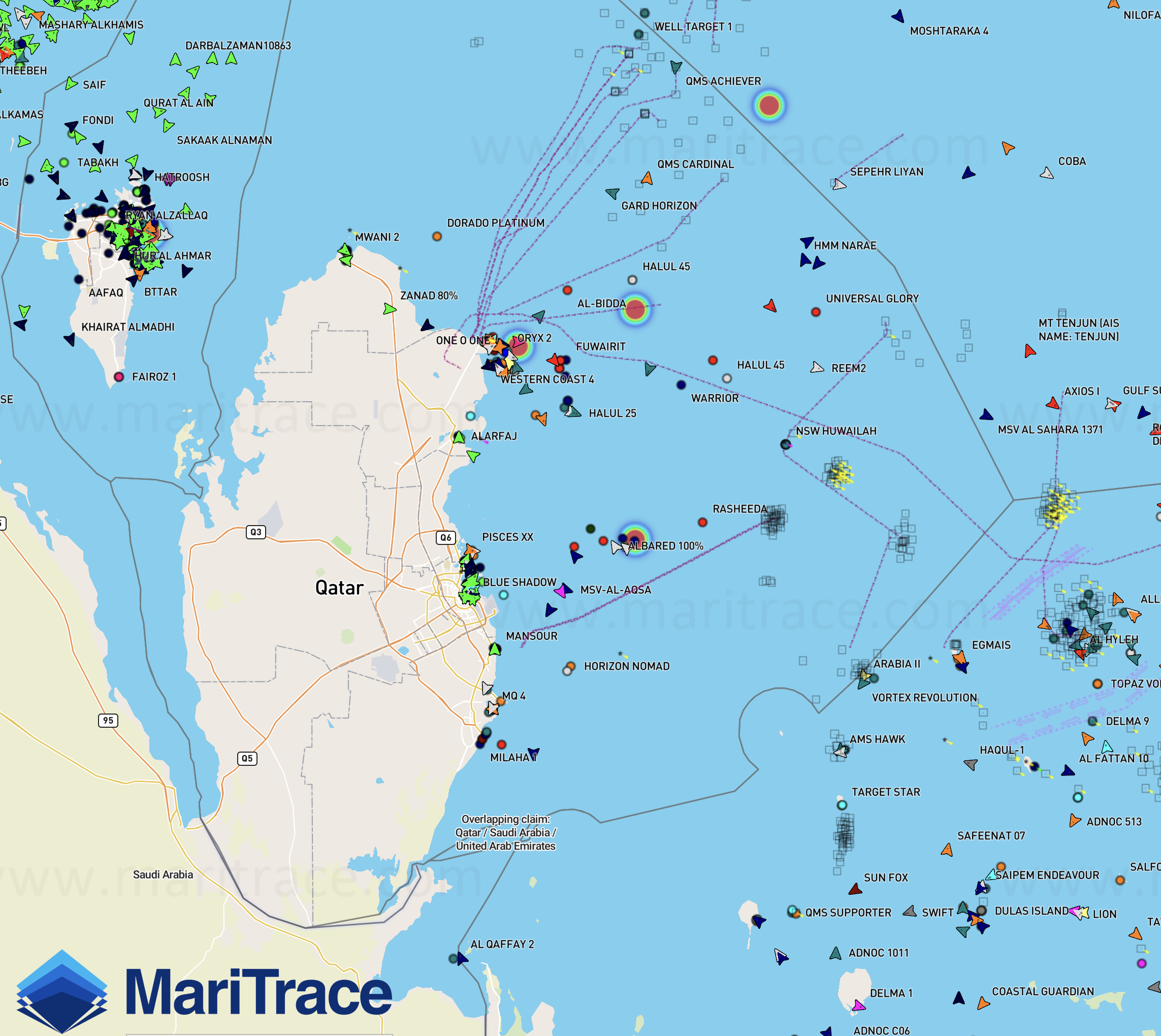
Vessels around Qatar as of 11th May 2026 with locations of recent incidents (image courtesy of www.maritrace.com)
A bulk carrier was struck by an unknown projectile on the morning of 10 May while sailing 23 nautical miles north-east of Doha, according to a UKMTO warning recorded in the agency's incident log. The master reported a fire on board, which was extinguished, with no casualties or pollution.
Qatar's Ministry of Defence later issued a statement carried by The Peninsula Qatar confirming that a commercial cargo vessel inbound from Abu Dhabi had been targeted by a drone in Qatari territorial waters north-east of Mesaieed Port, that a "limited fire" had been brought under control, and that the vessel had resumed her passage. The flag of the affected vessel was reported as American by Iran's Fars news agency and picked up by Al Jazeera and other outlets; at time of writing it had not been independently confirmed by Doha or by Washington. Bloomberg reported the incident the same day. Al Jazeera's account also referred to drone activity directed at Gulf states more broadly during the same period.
Mesaieed sits roughly 40 km south of Doha on the same east-facing coast, so UKMTO's "23 nm north-east of Doha" and the Qatari Ministry's description of a position north-east of Mesaieed describe the same point in the inner Gulf, on the inbound approach from Abu Dhabi rather than on the Hormuz transit. According to Qatar Energy's port information and other published port references, Mesaieed handles a multi-product mix that includes crude oil, condensate, refined products, LPG, naphtha and petrochemicals.
For context on how today's strike fits in: United Against Nuclear Iran's daily shipping update for 8 May recorded 42 confirmed maritime incidents involving commercial vessels and offshore infrastructure across the Arabian Gulf, the Strait of Hormuz and the Gulf of Oman since the start of hostilities on 28 February. The JMIC Advisory Note Update 041, covering the period to 5 May, recorded 37 incidents over the same window. Both pre-date the Mesaieed strike, the 10 May Gulf drone activity reported by Al Jazeera, and the US strikes on two Iranian tankers on 8 May during the naval blockade of Iranian ports. Five days before Mesaieed, the Maltese-flagged container ship CMA CGM San Antonio was attacked while transiting the Strait of Hormuz. The vessel's operator confirmed the attack and the resulting damage; the Philippines' Department of Migrant Workers reported seven Filipino seafarers injured, three in serious condition, while earlier wire copy citing the UN's International Maritime Organization had said eight; the discrepancy has not been reconciled in public reporting. The weapon type also remains disputed, with reports referring variously to a drone and to a cruise missile.
On the same day as the CMA CGM attack, President Trump paused the US Navy's "Project Freedom" escort corridor, launched 24 hours earlier, citing progress on an Iran agreement. The Joint Maritime Information Center established an "enhanced security area" inside Omani waters, south of the Hormuz Traffic Separation Scheme, effective 4 May, warning that the standard TSS lanes were "extremely hazardous" because of unmitigated mine threats.
On the insurance side, the picture is unchanged from earlier in the quarter. On 1 March, members of the International Group of P&I Clubs — including Gard, Skuld, NorthStandard, the London P&I Club, the American Club and Steamship Mutual — issued 72-hour notices of cancellation for certain war-risk covers tied to Iran and adjacent Gulf waters, with effect from 00:00 GMT on 5 March; the same picture was reported by Bloomberg and Al Jazeera. Lloyd's List has cited indicative war-risk premiums of US$10–14 million for a hypothetical VLCC voyage through the Strait, and has separately reported that vessels with perceived US, UK or Israeli association are paying roughly three times the baseline rate. Washington has stood up a US$20 billion DFC reinsurance facility intended to keep cover available for US-linked tonnage. The Lloyd's Market Association has separately argued that reduced traffic through the Strait is being driven by safety concerns rather than the availability of insurance, with hundreds of commercial vessels at anchor on both sides of the choke point.
For now: the affected bulk carrier is alongside in port, the fire is out, and Qatar's authorities are investigating. The wider picture as of this morning is a nominal US–Iran ceasefire, an active targeting environment across the inner Gulf, restricted lanes, war-risk pricing at levels documented by Lloyd's List, and a backlog of stranded tonnage.
Sources
Bloomberg — Drone Hits Ship Near Qatar as US Awaits Iran Peace Plan Response
Al Jazeera — US-Iran ceasefire under strain as Gulf states report drone attacks
United Against Nuclear Iran — Iran War Shipping Update, 8 May 2026
NPR — U.S. attacks Iranian tankers trying to skirt naval blockade
Seatrade Maritime — CMA CGM container ship attacked in Strait of Hormuz
Gulf News — 7 Filipino seafarers injured in Iran-linked attack on CMA CGM San Antonio
Al Jazeera — Trump announces pause on US operation to unblock Strait of Hormuz
Maritime Sutra — JMIC Establishes an "Enhanced Security Area" in SOH
gCaptain — Gulf War Risk Insurance Pulled as Reinsurers Exit
Bloomberg — Major Insurance Clubs to End Ship War-Risk Cover in Persian Gulf
Al Jazeera — Maritime insurers cancel war risk cover in Gulf
Lloyd's List — Gulf war risk premiums topping double-digit millions of dollars per trip
Lloyd's List — US, UK and Israeli ships charged three times more than others
Lloyd's List — US launches $20bn reinsurance facility for Gulf shipping