
The Strait of Hormuz Blockade: Dual Sieges, Million-Dollar Tolls, and 1,550 Ships in Limbo
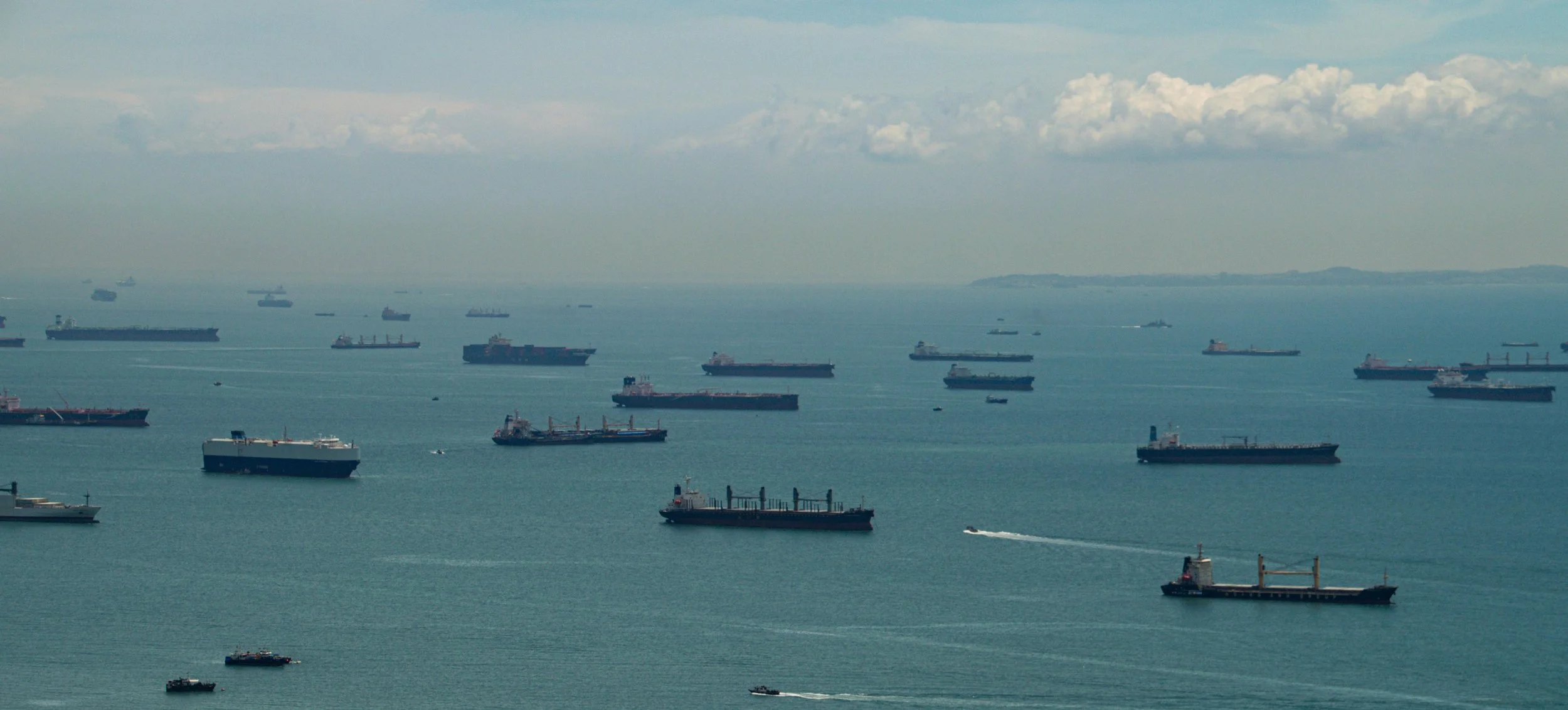
Ships at anchor
Commercial shipping through the Strait of Hormuz has been largely suspended since 28 February 2026, when IRGC forces began denying transit to most foreign-flagged vessels within hours of US-Israeli airstrikes on Iran. Nearly three months on, around 1,550 vessels remain stranded in the Persian Gulf or its approaches, with more than 20,000 mariners stranded aboard — figures cited by Chairman of the Joint Chiefs of Staff General Dan Caine on 6 May, and corroborated by separate reporting. Many of those vessels are unable to load, discharge, or clear the chokepoint that ordinarily handles around 20% of the world's seaborne oil trade and 20% of global LNG.
The closure took hold within hours of the opening strikes. IRGC commanders broadcast VHF warnings to all vessels in the strait on the night of 28 February; by 2 March a senior IRGC official publicly confirmed the closure. Ship-tracking data showed commercial AIS traffic through the strait fall to near zero by 1–2 March. By 5 March, war risk insurance premiums for the strait had risen to between four and six times their pre-war level, according to CNBC and industry sources, while US officials explored support measures for maritime insurers. Cover remained technically available, but the combination of sharply elevated rates and crew refusal rights under high-risk area designations made transit commercially unattractive or operationally unacceptable for many owners. Iran deployed four overlapping enforcement mechanisms: IRGC fast-boat intercepts; missile and drone strikes against vessels that attempted transit; sea mines laid in the main channel, which US intelligence first confirmed on 10 March; and satellite spoofing combined with GNSS jamming that degrades navigation independently of any direct threat. By 12 March, UKMTO had logged 16 attacks and four suspicious incidents in the Gulf since hostilities began. More than two dozen merchant vessels had been attacked in the weeks that followed, with two container ships — the Epaminondas and the MSC Francesca — seized and held by the IRGC, and at least 11 seafarers killed in maritime incidents in the Middle East since the crisis began, according to reporting across multiple outlets.
The geometry of the crisis changed structurally on 13 April, when the US Navy declared a blockade of Iranian ports and coastal areas after nuclear talks collapsed in Islamabad. CENTCOM clarified that the US blockade applies to vessels entering or leaving Iranian ports rather than to ships transiting the strait to non-Iranian destinations — but in practice, the combination of Iran's closure and the US counter-blockade has produced what the Guardian and other outlets have characterised as a "dual blockade": two navies constricting traffic from opposite directions. Bloomberg's Hormuz Tracker recorded five transits on 15 May, ten on 16 May, and none by Sunday morning on 17 May — almost all Iranian-linked movements.
In that gap, Iran has constructed an explicit bilateral transit regime. From early March, Chinese-owned and Chinese-flagged bulk carriers began broadcasting their ownership status and passing without incident. Iranian officials stated in late March that selected states — including China and several regional partners — would be permitted to transit under bilateral arrangements, with several other nations subsequently seeking similar agreements with Tehran. Iran also established a separate shipping channel north of Larak Island, distinct from the main lane south of the island, with at least one vessel reported to have paid $2 million to use it. According to Lloyd's List, tolls were being denominated in Chinese yuan. For operators whose vessels fall outside those bilateral arrangements, the strait is currently considered effectively impassable without accepting significant interception or attack risk.
For those who do hold cargo inside the Gulf, alternative evacuation routes exist but cover only a fraction of normal throughput. Saudi Arabia has accelerated crude diversions through the East–West Pipeline to Yanbu on the Red Sea; the UAE is routing volumes via the Abu Dhabi Crude Oil Pipeline to the Gulf of Oman port of Fujairah. Iraq has partial use of the Kirkuk–Ceyhan pipeline to the Turkish Mediterranean coast. Combined capacity across those alternatives runs to around 9 million barrels per day — roughly half the 20 million that transited the strait before the crisis. Oman's deep-water ports at Duqm and Salalah offered a partial bypass route through Omani territorial waters, but Iranian drone strikes hit fuel storage at Duqm in March, and the Joint War Committee of the London insurance market has since included waters around Oman in its high-risk zone. The Saudi Red Sea route via Yanbu has remained operationally open, though its pipeline capacity alone cannot compensate for the loss of Hormuz volume.
For operators now navigating the region, the current advisory framework is MARAD 2026-004, which supersedes earlier advisories and remains in effect until September 2026. It instructs US-flagged vessels to conduct pre-voyage risk assessments, maintain a minimum 30-nautical-mile standoff from US military ships, monitor VHF Channel 16, and comply with instructions from coalition navies. The US Navy launched mine-clearance operations in the strait from 11 April; CENTCOM confirmed those operations to the Wall Street Journal, which reported separately that Iran had itself lost track of some of the mines it planted, adding a residual navigation hazard that neither side can resolve unilaterally. The UK has deployed drones, fighter aircraft, and a Royal Navy warship to an international defensive mission in support of commercial shipping. Indian media have reported that the navy is running Operation Urja Suraksha, deploying multiple frontline warships to escort Indian-flagged cargo in the region.
As of 20 May, the Strait of Hormuz remains largely closed to most commercial traffic. The mine threat in the transit channel has not been fully cleared. The dual-blockade framework — Iran restricting traffic by flag state, the US enforcing a counter-blockade on Iranian ports — remains operative. The more than 20,000 mariners stranded aboard vessels in the Gulf face mounting welfare obligations under MLC 2006, with some having been aboard for months without a port call, and with no agreed diplomatic mechanism for full normalisation currently in place.
MariTrace tracks vessel positions, AIS anomalies, and incident reports across the Persian Gulf, Strait of Hormuz, and Gulf of Oman; the platform is at maritrace.com.
SOURCES
HORMUZ TRACKER: Gridlock Persists While Blocked Tanker Sails On — Bloomberg, 17 May 2026
MARAD Advisory 2026-004 — US Department of Transportation Maritime Administration
Uncertainty continues over safety in the Strait of Hormuz — UN News, May 2026
Strait of Hormuz sees more attacks on ships as US–Iran standoff continues — Reason, 14 May 2026
US MARAD issues guidance for vessels transiting the Strait of Hormuz — SAFETY4SEA
Tensions flare near Strait of Hormuz as a ship is seized and another is sunk — PBS News, 15 May 2026